What is the difference between a GPU and an NPU?+
A GPU (Graphics Processing Unit) is a general-purpose parallel processor with many cores, excellent at matrix math and flexible enough for training and rendering. An NPU (Neural Processing Unit) is a specialized chip designed only for neural-network inference and training, with dataflow architectures that trade flexibility for higher efficiency. In short: GPU is general-purpose and programmable; NPU is domain-specific and more power-efficient for fixed AI workloads.
What is an AI accelerator card?+
An AI accelerator card is a PCIe or OAM add-in card that offloads machine-learning training and inference from the CPU. It typically carries a GPU, NPU or ASIC plus high-bandwidth memory (HBM) and is used in servers and workstations to run large neural networks efficiently.
What is the difference between GPGPU and a gaming GPU?+
A gaming GPU is tuned for raster graphics and framed around real-time rendering. A GPGPU (General-Purpose GPU) is the same silicon family but optimized and marketed for compute: larger memory, ECC support, better FP64/FP8 throughput, server cooling and virtualization. Cards like the NVIDIA A100/H100 are GPGPUs, while GeForce RTX is aimed at games.
What are Tensor Cores?+
Tensor Cores are specialized units inside NVIDIA GPUs that perform mixed-precision matrix multiply-and-accumulate in a single operation. They dramatically accelerate deep-learning math at FP16, BF16, FP8 and FP4 while using less power than CUDA cores doing the same work.
GPU vs NPU vs TPU vs ASIC: which to choose?+
GPU is the most flexible and mature, ideal for research and mixed workloads. NPU suits on-device and inference-heavy deployments. TPU is Googles matrix-multiply ASIC, excellent for TensorFlow/JAX at scale but cloud-locked. ASIC offers the best efficiency for one fixed workload but no flexibility. Choose by workload stability, ecosystem and scale.
What is the difference between training and inference hardware needs?+
Training needs very high compute throughput, large memory capacity and fast interconnect to scale across many GPUs. Inference prioritizes low latency, high throughput per watt, lower precision (INT8/FP8/FP4) and cost. Training cards are usually top-tier (H100/B200); inference can use mid-range or NPU/ASIC solutions.
What is a dataflow architecture?+
A dataflow architecture executes operations as data becomes available, rather than fetching instructions from memory one by one (von Neumann style). NPUs and TPUs use this to keep large matrix operations fed with minimal overhead, improving efficiency for neural networks at the cost of program flexibility.
What is a chiplet and why does it matter for AI chips?+
A chiplet is a small modular die that is packaged together with other dies to form one chip. It improves yield, lets vendors mix process nodes (compute on 4nm, I/O on 6nm) and scales beyond reticle limits. AMD MI300 and Intels approaches use chiplets to build large accelerators cost-effectively.
What is HBM and how is it different from GDDR?+
HBM (High Bandwidth Memory) stacks DRAM vertically and connects via a wide 1024/2048-bit interposer, delivering far higher bandwidth and lower power than GDDR, which uses wide-but-shorter parallel buses on the PCB. AI accelerators use HBM3/HBM3e/HBM4 because large models are memory-bandwidth bound.
What is CoWoS and why is it a bottleneck?+
CoWoS is TSMCs 2.5D packaging technology that places a GPU die next to HBM stacks on a silicon interposer. Advanced AI chips depend on it, and limited CoWoS capacity has been a key supply constraint for NVIDIA/AMD accelerators.
What is NVLink used for?+
NVLink is NVIDIs high-speed GPU-to-GPU interconnect, allowing direct memory sharing and coherent access between GPUs at hundreds of GB/s. It is used to build multi-GPU servers (HGX/DGX) so models larger than one cards memory can be sharded efficiently.
What does OAM mean in AI accelerator modules?+
OAM (OCP Accelerator Module) is an open hardware standard from the Open Compute Project defining the module form factor, cooling and high-speed interfaces for AI accelerators. It lets different vendors cards fit the same server baseboard, easing system integration.
Is more VRAM always better?+
Not always. Larger VRAM lets you hold bigger models and batches, but if the workload is compute-bound, extra memory adds cost without speed gains. Bandwidth often matters more than raw capacity. Match VRAM to model size plus KV-cache headroom.
What is a GPU cluster?+
A GPU cluster connects many accelerator servers with high-speed networking (InfiniBand/RoCE) so they train or serve models in parallel. Scaling out requires both fast internode networking and parallelism strategies (data, tensor, pipeline parallelism).
Can a consumer GPU be used for AI training?+
Yes for small models and fine-tuning, using cards like RTX 4090. Limits include smaller VRAM (24GB), no ECC, weaker FP8/FP4 support, consumer cooling and no NVLink. For serious training, datacenter cards are more reliable and scalable.
What do FP64, FP32, FP16, BF16, FP8 and FP4 mean?+
They are numeric precisions. FP64/FP32 are high precision for scientific/HPC work; FP16 and BF16 are half precision widely used in AI training; FP8 and FP4 are lower precisions used in inference to double throughput and cut memory. Fewer bits mean faster and smaller but lower accuracy.
What is TFLOPS and how should I read it?+
TFLOPS means trillion floating-point operations per second. Always check the precision and density basis: 989 TFLOPS FP16 dense is very different from 1979 TFLOPS FP8 sparse. Compare cards only at the same precision and same sparse/dense basis.
Why is sparse compute often double the dense figure?+
Structured sparsity (e.g. 2:4) skips every other zero value in a pattern, letting hardware double useful throughput. Vendors quote sparse numbers because they look higher, but real-world gains depend on whether the model and framework exploit 2:4 sparsity. Always cite dense figures for fair comparison.
What is the difference between TFLOPS and TOPS?+
TFLOPS counts floating-point operations; TOPS counts integer operations (typically INT8). Inference specs often quote TOPS because quantized integer inference is common. Converting between them requires knowing the precision used.
Why is memory bandwidth critical for large model inference?+
Autoregressive generation is memory-bandwidth bound: each token requires reading the entire model weights from HBM. Higher bandwidth (TB/s) directly increases tokens-per-second, often more than raw TFLOPS. This is why H100/H200/B200 emphasize HBM bandwidth.
What is TDP and how does it affect cooling?+
TDP (Thermal Design Power) is the maximum heat a chip is expected to dissipate under typical load, in watts. A 700W part needs liquid cooling and a beefy power supply; a 300W part may work with air. Higher TDP usually means more performance but higher operating cost.
What is FP8 and why is it popular now?+
FP8 uses 8 bits per number, halving memory and doubling throughput versus FP16 with acceptable accuracy for many LLM workloads. Hardware support in H100/B200 and frameworks like Transformer Engine made FP8 practical for both inference and training.
What is BF16 and how does it compare to FP16?+
Both are 16-bit. FP16 has more mantissa bits (better precision) but a narrow range and can overflow in training. BF16 has fewer mantissa bits but the same wide exponent range as FP32, making it more stable for training without loss-scaling. Most new LLMs train in BF16.
What is quantization and how does it affect accuracy?+
Quantization converts weights/activations from FP16 to lower precision like INT8 or FP4 to save memory and speed up inference. It can slightly reduce accuracy, but techniques like calibration and mixed precision keep the loss small for most models.
What is the difference between dense and sparse memory?+
This usually refers to structured sparsity in compute, not memory itself. Sparse compute uses 2:4 patterns to skip zeros; memory capacity and bandwidth stay the same. Some LLMs use weight sparsity to fit more parameters, but that is a model technique, not a hardware spec.
What does memory capacity determine?+
VRAM capacity determines the largest model (weights + optimizer states during training, weights + KV cache during inference) that fits on a card. If the model does not fit, you must shard across GPUs, offload to CPU, or use quantization.
What is interconnect bandwidth (NVLink) measured in TB/s?+
It is the aggregate data rate between GPUs in a server. Higher interconnect bandwidth reduces the cost of tensor/pipeline parallelism and AllReduce operations, which dominate multi-GPU training and inference latency.
How do I compare accelerators from different vendors fairly?+
Normalize to the same precision, same sparse/dense basis, and real-world workload benchmarks rather than peak specs. Also weigh memory bandwidth, interconnect, software ecosystem and total cost of ownership. Peak TFLOPS alone is misleading.
What is a PropertyValue spec sheet used for?+
A structured spec sheet lists every key attribute (memory, bandwidth, precision throughput, TDP) in a machine-readable form, so buyers can filter and compare consistently and search engines can index the data accurately.
What is performance per watt and why does it matter?+
Performance per watt measures throughput divided by power draw. In datacenters, power and cooling are a large share of TCO, so a more efficient card can be cheaper over its lifetime even at a higher purchase price.
What does "dense FP4 PFLOPS" mean on a spec card?+
It is the peak throughput in FP4 precision without sparsity, measured in petaflops (10^15 ops/s). Blackwell cards list dense FP4 (e.g. B200 ~9 PFLOPS dense) and an even higher sparse figure. Use dense for honest comparisons.
Why do specs list both FP16 and FP8 throughput?+
Because throughput roughly doubles as precision halves: FP8 is typically 2x FP16, FP4 2x FP8. Listing each lets buyers estimate performance for different model precisions and inference optimizations.
What is the difference between H100 and H200?+
Both use the Hopper architecture with the same compute core. H200 upgrades to 141GB HBM3e with 4.8 TB/s bandwidth (vs 80GB/3.35 TB/s on H100), roughly doubling large-model inference speed. Compute is essentially unchanged.
How much faster is B200 than H100?+
NVIDIA claims B200 delivers up to 4x training and 15x inference throughput over H100, enabled by Blackwell architecture, FP4 support and 192GB HBM3e at 8 TB/s. Actual gains depend on model, precision and software maturity.
What is Blackwell Ultra B300?+
B300 is the refreshed Blackwell Ultra GPU with 288GB HBM3e for long-context inference, higher FP4 throughput than B200 and is the core of GB300 NVL72 systems. It targets reasoning models that need large memory and high bandwidth.
What is GB200 and how does it relate to B200?+
GB200 is a superchip pairing one Grace CPU with two B200 GPUs, connected by NVLink-C2C. It ships in NVL72 racks that link 72 GPUs, aimed at trillion-parameter training and inference. B200 is the GPU itself; GB200 is the CPU+GPU module.
What is NVIDIA Rubin and when does it arrive?+
Rubin is NVIDIs next architecture after Blackwell, expected in 2026 with HBM4, 50 PFLOPS FP4 and claims of 10x lower inference cost vs Blackwell. It is the follow-on to the Hopper/Blackwell roadmap.
What is the H20 and why is it sold in China?+
H20 is a Hopper-based GPU configured to meet earlier US export rules, with reduced compute but 96GB HBM3 and strong NVLink. It was designed specifically for the China market; availability is subject to changing export controls.
What is L40S good for?+
L40S is an Ada-based PCIe card with 48GB GDDR6 and strong FP8/BF16 throughput, aimed at inference, graphics and video workloads where large HBM is not essential. It is a cost-effective choice for mid-range serving.
What is CUDA and why is it a moat?+
CUDA is NVIDIs parallel computing platform and programming model, with a vast ecosystem of libraries (cuDNN, cuBLAS, NCCL) and developer tooling. Years of optimization and compatibility make migrating to competitors costly, which is NVIDIs key software moat.
SXM vs PCIe GPU: what is the difference?+
SXM is a high-bandwidth socket used in HGX/DGX servers with better power delivery, cooling and NVLink bandwidth. PCIe cards are plug-in, more flexible and easier to service but have lower interconnect bandwidth and power limits.
What is HGX and DGX?+
HGX is NVIDIs OEM baseboard reference design integrating multiple SXM GPUs and NVLink switches; server vendors build systems on it. DGX is NVIDIs own complete, validated AI appliance (hardware + software stack) for turnkey deployment.
What is TensorRT?+
TensorRT is NVIDIs inference optimizer and runtime. It fuses layers, calibrates INT8/FP8 quantization and tunes kernels for a specific GPU, significantly boosting inference throughput and lowering latency for deployed models.
What is Transformer Engine?+
Transformer Engine is an NVIDIA library that automatically manages FP8 precision for transformer layers, using techniques like per-tensor scaling to preserve accuracy while exploiting FP8 speed on Hopper and Blackwell GPUs.
HBM3 vs HBM3e vs HBM4: what changed?+
Each generation raises per-pin speed and capacity. HBM3e is a faster refresh of HBM3 used in H200/B200; HBM4 widens the interface and is used in Rubin-era parts. Newer HBM means higher bandwidth and larger stacks.
What is NCCL?+
NCCL (NVIDIA Collective Communications Library) implements optimized multi-GPU collectives like AllReduce and AllGather over NVLink and InfiniBand. It is the backbone of distributed training on NVIDIA hardware.
Is an older A100 still worth buying?+
A100 remains capable for many workloads and is cheaper on the used market, but it lacks FP8/FP4 and has less bandwidth than H100/B200. It is reasonable for budget inference and fine-tuning, less so for cutting-edge training.
What is NVLink Switch and why does it matter?+
NVLink Switch is a chip that connects many GPUs into a single high-bandwidth domain, enabling all-to-all communication at scale. It is the backbone of NVSwitch-based servers and GB200 NVL racks, letting dozens of GPUs act like one large accelerator.
How does AMD MI300X compare to H100?+
MI300X offers 192GB HBM3 and higher memory bandwidth than H100, with competitive FP8/FP16 throughput, making it strong for large-model inference. It uses chiplet construction. The main trade-off is a less mature software ecosystem (ROCm vs CUDA).
What is AMD MI355X?+
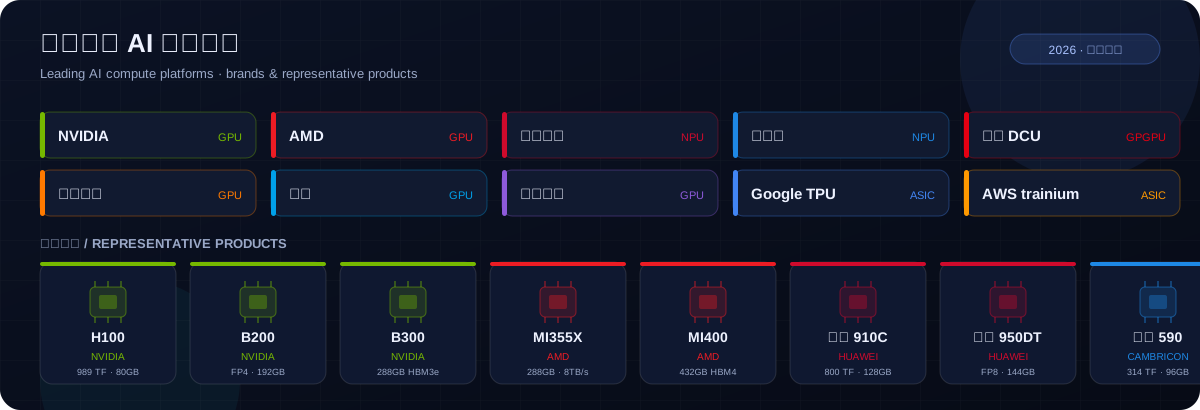
MI355X is AMDs Blackwell-generation Instinct accelerator with 288GB HBM3e and 8 TB/s bandwidth, targeting large-scale AI training and inference. It is the successor line to MI300X.
What is AMD MI400 series?+
MI400 is AMDs next-generation Instinct line expected with 432GB HBM4, aimed at competing with NVIDIs Rubin era. It targets ultra-large model training and long-context inference.
Is ROCm mature enough for production?+
ROCm has improved substantially and supports PyTorch and major frameworks, but it still trails CUDA in library coverage, tooling and community support. It is viable for many inference and training workloads, but migration may need engineering effort.
What is Google TPU v6e (Trillium)?+
TPU v6e is Googles sixth-generation tensor processing unit with improved performance and memory per chip, available through Google Cloud. It excels at TensorFlow/JAX workloads at scale but is not sold as a standalone card.
What is AWS Trainium2 used for?+
Trainium2 is AWSs custom training ASIC offered in EC2 instances, designed to cut cost for large-model training within the AWS ecosystem. It is tightly integrated with AWS tooling but not generally available as a standalone card.
What is the difference between inference and training ASICs?+
Training ASICs emphasize high precision throughput, large memory and scalability; inference ASICs prioritize low latency, low precision (INT8/FP8) and cost per token. Examples: AWS Trainium (training) vs Inferentia (inference).
What is Intel Gaudi?+
Gaudi is Intels AI accelerator family (Habana Labs) positioned as a CUDA-alternative for training and inference, with open software support. It aims to offer competitive price-performance in hyperscale deployments.
Are there GPU vendors besides NVIDIA and AMD?+
For AI compute, notable names include Intel, and in China Moore Threads, MetaX, Biren and Hygon. Each has its own software stack and ecosystem maturity, with NVIDIA still dominating overall.
What is AMD Infinity Fabric?+
Infinity Fabric is AMDs high-speed interconnect used both on-chip (between chiplets) and between GPUs/CPUs in servers. In Instinct platforms it links multiple GPUs and to EPYC CPUs, playing a role similar to NVIDIs NVLink.
What is Huawei Ascend 910C?+
Ascend 910C is Huaweis flagship AI chip, roughly 800 TFLOPS FP16 with 128GB HBM, built on a dual-die package. It is the core of CloudMatrix/Atlas supernodes and the leading domestic alternative for training and inference in China.
How does Ascend 910C compare to H100?+
910C offers competitive FP16 compute and large memory but its single-card performance is generally below H100; its strength is scale-out via supernodes (CloudMatrix) and domestic availability. Software uses MindSpore/CANN rather than CUDA.
What is Ascend 950DT?+
Ascend 950DT is Huaweis next-generation training chip in the Ascend roadmap, with FP8 support and around 144GB HBM, aimed at large-model training with improved interconnect.
What is Cambricon Siyuan 590?+
Siyuan 590 is Cambricons data-center AI chip with roughly 314 TFLOPS FP16 and 96GB memory, positioned for inference and moderate training in domestic deployments.
What is Hygon DCU K100?+
K100 is Hygons DCU (Deep Compute Unit) accelerator based on a GPGPU-like architecture, supporting the ROCm-compatible ecosystem and used for domestic AI training and HPC.
What is Baidu Kunlunxin P800?+
Kunlunxin P800 is Baidus second-generation AI accelerator used in its cloud and PaddlePaddle ecosystem, focused on inference and training for Chinese workloads.
What is Moore Threads MTT S4000?+
MTT S4000 is Moore Threads data-center GPU aimed at AI training and inference, with its MUSA software stack positioning it as a domestic full-function GPU alternative.
What is MetaX C600?+
C600 (Xiyun) is MetaXs general-purpose GPU for AI compute, with its MACA software stack, targeting training, inference and graphics workloads in China.
What is Biren BR100?+
BR100 is Biren Technologys general-purpose GPU with high FP16/FP32 throughput aimed at AI training and inference, one of the first domestic high-end GPGPUs.
What is Moonshot AI known for?+
Moonshot AI is a Chinese LLM company best known for the Kimi assistant and long-context models such as Kimi K2/K3, competing with other leading Chinese model providers.
What is Zhipu AI GLM?+
Zhipu AI develops the GLM series of large models (e.g. GLM-4/5), offering strong Chinese-language and coding capabilities via its API and open models.
What is Tencent Hunyuan?+
Hunyuan is Tencents family of large models, including text, image and video models. Hunyuan T1 is a reasoning-oriented model offered through Tencent Cloud.
What is Baidu Qianfan / ERNIE?+
Qianfan is Baidus model platform; ERNIE (Wenxin) is its large-model family. Together they provide model training, deployment and APIs for Chinese enterprise applications.
What is CloudMatrix from Huawei?+
CloudMatrix is Huaweis supernode architecture that interconnects many Ascend chips with high-bandwidth optical links to form a large unified compute pool. It is Ascend 910Cs answer to NVIDIs NVL72 rack-scale systems.
How much VRAM does a 70B model need?+
In FP16, weights alone need ~140GB, so a 70B model needs at least two 80GB cards just for weights, more for KV cache. With INT8/INT4 quantization, ~70GB/35GB respectively. Training needs far more (weights + gradients + optimizer states).
What is a token and how is LLM pricing calculated?+
A token is a chunk of text (roughly 4 characters in English). API pricing is usually per million tokens, split into input and output rates, with cached input cheaper. Videos may be priced per second at different resolutions.
Why are LLM APIs billed per million tokens?+
Token count correlates with compute and memory used, giving a fair, granular unit for both short and long requests. Per-million rates are a convenient way to quote small per-token costs.
What is context length and why does it matter?+
Context length is the maximum number of tokens a model can process in one request. Longer context enables document analysis and long conversations but increases KV-cache memory and attention cost, requiring more VRAM and bandwidth.
What is KV cache and how does it use memory?+
KV cache stores previous attention keys/values so the model does not recompute them when generating each new token. It speeds generation but consumes memory proportional to context length, batch size and number of layers — often the main VRAM limit for long contexts.
How does batch size affect throughput and latency?+
Larger batches improve GPU utilization and throughput (tokens/sec) by amortizing weight reads, but increase latency per request and KV-cache memory. Serving systems tune batch size to balance throughput and latency targets.
What is tensor parallelism?+
Tensor parallelism splits individual matrix operations (e.g. attention heads) across multiple GPUs, so a single layer can use combined compute and memory. It needs very fast interconnect (NVLink) because GPUs exchange partial results constantly.
What is pipeline parallelism?+
Pipeline parallelism assigns different model layers to different GPUs, passing activations along. It reduces per-card memory but can create idle bubbles; combined with tensor and data parallelism it scales very large models.
What is data parallelism?+
Data parallelism copies the full model to each GPU and feeds different batches, then synchronizes gradients (AllReduce). It is the simplest scaling method but requires the whole model to fit on each card.
What is an MoE model and its hardware needs?+
Mixture-of-Experts models activate only a subset of parameters per token, offering large capacity with lower compute per token. They need big memory to hold all experts and fast interconnect for routing, favoring high-bandwidth, high-memory cards.
What is Seedance and why is it featured?+
Seedance is ByteDances video-generation model family (2.0/2.5 and variants) available via Volcano Engine. We feature it because our current pricing is especially competitive — billed per second at 480P/720P/1080P starting around ¥0.70/s — contact us for a quote.
How does video generation differ from text LLM compute?+
Video generation produces many high-dimensional frames and is usually sold per second of output at a given resolution. It is compute- and bandwidth-heavy with strong GPU demand, distinct from token-based text pricing.
How do I estimate inference cost per token?+
Divide the hourly cost of the accelerator by tokens generated per hour, accounting for utilization. Faster cards with higher bandwidth generate more tokens/sec, lowering cost per token even if hourly rental is higher.
What is speculative decoding?+
Speculative decoding uses a small, fast model to draft several tokens which the large model verifies in one pass. It speeds up generation without changing output quality, and benefits from high memory bandwidth and low-latency GPUs.
What specs should I check before buying an accelerator?+
Check precision-labeled throughput (dense vs sparse), VRAM capacity and type, memory bandwidth, TDP, interconnect, form factor (PCIe/OAM) and software ecosystem. Match them to your model size and workload rather than chasing peak numbers.
Should I buy different cards for training and inference?+
Often yes. Training needs top-tier compute, memory and interconnect (H100/B200/MI300X), while inference can use cheaper cards or NPU/ASIC with lower precision. Mixed deployments optimize cost by separating the two.
How do I choose VRAM capacity on a budget?+
First decide target models and precision, then compute weights + KV-cache headroom. Prefer quantization (INT8/INT4) to fit, and prioritize bandwidth over raw capacity if compute-bound. Consider used or mid-range cards.
What should I consider when scaling to multiple GPUs?+
Ensure fast GPU-to-GPU interconnect (NVLink/PCIe Gen5), high-bandwidth networking (InfiniBand/RoCE) between nodes, adequate power and cooling, and software that supports the needed parallelism strategy.
What are the power and cooling requirements for AI servers?+
High-end cards (700W TDP) often require liquid cooling and redundant PSUs; plan ~1.5-2kW per server and adequate facility cooling. Air cooling suits lower-TDP cards. Check rack density and PSU headroom.
Cloud vs on-premise GPUs: which is better?+
Cloud offers elasticity and no upfront capex, good for variable workloads; on-premise wins on long-term cost, data control and availability for steady heavy use. Many teams use a hybrid of both.
How can I get a discount on accelerators or models?+
Use the Contact us for a discount form on each product or the Token Hub page, or email our team. We quote current street prices and volume discounts for both hardware and model API access.
How current is the pricing and spec data on this site?+
Specs come from vendor documents and public reports, collected in November 2026; prices are official list prices and may change. Contact us for current quotes — we label data collection dates and correct errors promptly.
What is the history of AI accelerator generations?+
From NVIDIs Volta and Ampere (A100) to Hopper (H100/H200) and Blackwell (B200/B300), each generation added lower precision support, more HBM and faster interconnect. The timeline on this site charts the key milestones from 2020 to 2026.
Why is the industry moving from single cards to clusters?+
Model sizes grow faster than single-card memory and compute, so scaling now depends on connecting many accelerators with fast interconnect. System-level design (network, parallelism, cooling) matters as much as the card itself.
What software stacks do different accelerators use?+
NVIDIA uses CUDA/cuDNN; AMD uses ROCm; Huawei Ascend uses CANN/MindSpore; Google TPU uses TensorFlow/JAX; Moore Threads uses MUSA; MetaX uses MACA. Ecosystem maturity strongly affects adoption.
What does "precision labeling" mean on this site?+
We label every compute figure with its precision (FP16/FP8/FP4) and whether it is sparse or dense, because peak numbers can be misleading. Comparing cards at mismatched precision is a common source of confusion.
Does this site provide investment or purchase advice?+
No. AI Computer Card provides technical education and spec lookup only. We do not give investment advice or price predictions. Pricing is indicative — contact us for quotes and consult your own advisors for purchases.
How do I report a data error or suggest a card?+
Use the contact form to report errors or request a card. We verify corrections against vendor documentation and update the database, noting collection dates for transparency.
No matching questions.